


Effective time management is essential for staying productive, organized, and focused in today’s busy world. Two popular productivity techniques that help people manage their schedules are time blocking and time boxing.
Although these methods are often confused, time blocking vs time boxing involves two different approaches to managing time. Time blocking helps you organize your schedule, while time boxing sets a specific time limit for completing a task.
Understanding the difference between time blocking and time boxing can help you choose the right productivity method for your work, studies, business, or personal goals.
What Is Time Blocking?
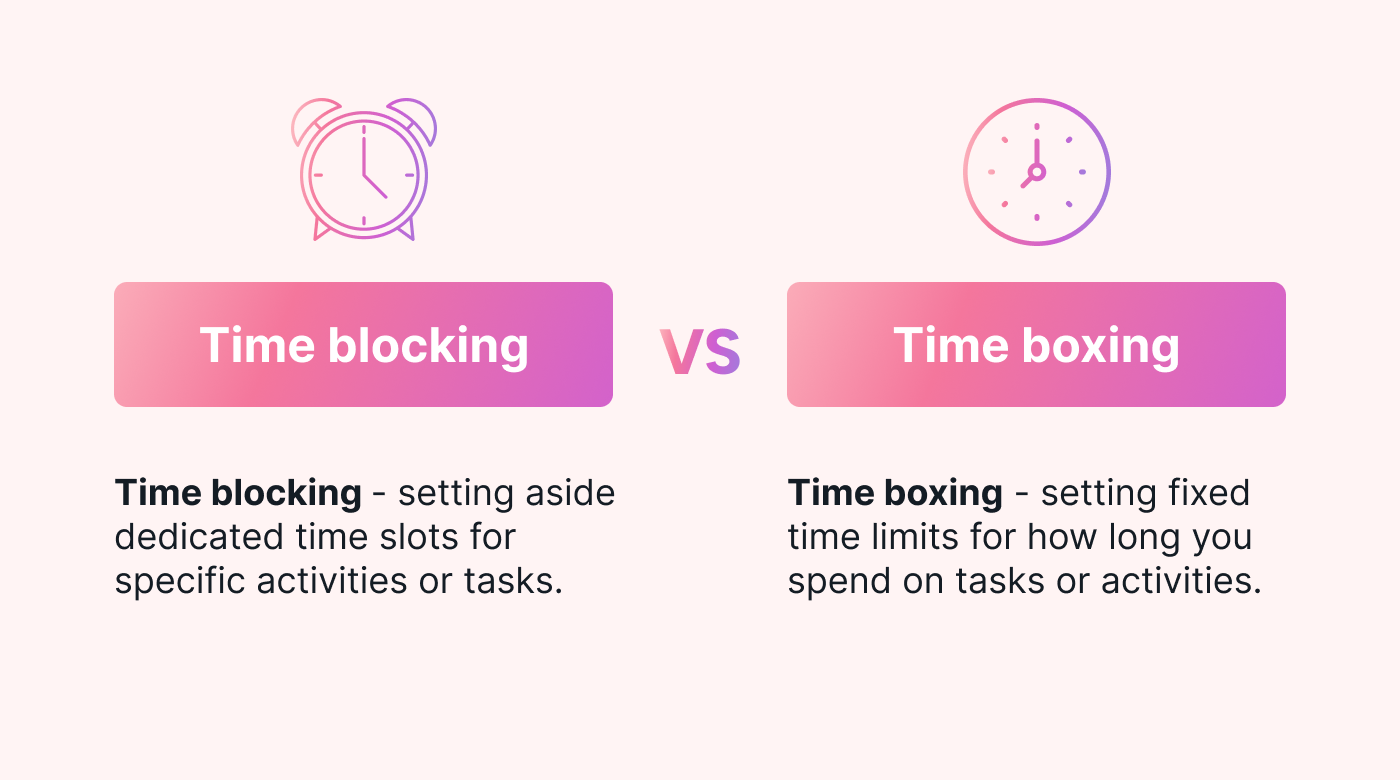
Time blocking is a time management technique that involves dividing your day into specific blocks of time. Each block is assigned to a particular task, activity, or category of work.
For example, a daily schedule using time blocking might look like this:
- 8:00 AM–9:00 AM: Email and daily planning
- 9:00 AM–11:00 AM: Deep work
- 11:00 AM–12:00 PM: Meetings
- 1:00 PM–3:00 PM: Project work
- 3:00 PM–4:00 PM: Administrative tasks
- 4:00 PM–5:00 PM: Review and planning
The goal of the time blocking method is to decide in advance when you will work on specific activities. Instead of constantly asking, “What should I do next?” you already have a structured plan for your day.
Benefits of Time Blocking
Time blocking can help you:
- Create a more organized daily schedule
- Prioritize important tasks
- Reduce distractions and multitasking
- Improve focus and concentration
- Protect time for deep work
- Manage multiple projects
- Build better productivity habits
Time blocking is especially useful for entrepreneurs, business owners, students, freelancers, remote workers, and professionals with busy schedules.
What Is Time Boxing?
Time boxing is a productivity technique where you assign a fixed amount of time to a specific task.
For example, instead of working on a task until it is finished, you might decide:
- 30 minutes for keyword research
- 45 minutes for writing
- 20 minutes for answering emails
- 60 minutes for completing a project
- 15 minutes for reviewing your work
When the time box ends, you stop working on the task or evaluate your progress.
The main purpose of the time boxing technique is to create a clear time limit. This can help you work with greater focus and prevent tasks from taking longer than necessary.
Benefits of Time Boxing
Time boxing can help you:
- Reduce procrastination
- Improve focus
- Avoid perfectionism
- Complete tasks more efficiently
- Create a sense of urgency
- Improve time awareness
- Prevent small tasks from taking too long
Time boxing is particularly helpful for people who struggle with procrastination or spend too much time trying to make every task perfect.
Time Blocking vs Time Boxing: What Is the Difference?
The main difference between time blocking vs time boxing is their purpose.
Time blocking organizes your day, while time boxing controls the amount of time you spend on a task.
For example, you may create a time block from 9:00 AM to 12:00 PM for content creation. Within that block, you can use time boxing to set limits for each task:
- 30 minutes for research
- 60 minutes for writing
- 30 minutes for editing
In this example, the three-hour period is the time block, while the individual time limits are the time boxes.
| Feature | Time Blocking | Time Boxing |
|---|---|---|
| Main purpose | Organize your schedule | Limit time spent on a task |
| Focus | When you will do something | How long you will do it |
| Best for | Daily planning | Focus and task completion |
| Structure | Divides your day into blocks | Assigns a fixed time limit |
| Example | 9–11 AM: Content creation | 60 minutes: Write an article |
Time Blocking vs Time Boxing: Which Is Better?
There is no single answer to which method is better. The best productivity technique depends on your specific needs.
Time Blocking May Be Better If You:
- Have a busy schedule
- Manage several projects
- Need better daily organization
- Have difficulty prioritizing tasks
- Want to create a consistent routine
- Need to protect time for important work
Time Boxing May Be Better If You:
- Frequently procrastinate
- Spend too much time on simple tasks
- Struggle with perfectionism
- Have difficulty starting projects
- Need deadlines to stay focused
- Want to complete tasks faster
For many people, the best solution is to combine time blocking and time boxing.
How to Combine Time Blocking and Time Boxing
You can use time blocking to plan your day and time boxing to manage individual tasks.
For example, your schedule could look like this:
9:00 AM–12:00 PM: Content Creation Block
Inside this time block:
- 9:00–9:30 AM: Keyword research
- 9:30–10:30 AM: Content writing
- 10:30–10:45 AM: Break
- 10:45–11:30 AM: SEO optimization
- 11:30 AM–12:00 PM: Editing and proofreading
The overall schedule is an example of time blocking, while the individual task limits are examples of time boxing.
This combination provides both structure and flexibility. You know what you need to work on and how long you should spend on each task.
Time Blocking and Time Boxing for Productivity
Both methods can improve productivity, but they solve different problems.
If you often feel overwhelmed because you have too many tasks and do not know where to start, time blocking can help you organize your day.
If you know what you need to do but keep spending too much time on certain tasks, time boxing can help you set boundaries.
Using both methods together can help you:
- Plan your priorities
- Improve concentration
- Reduce procrastination
- Complete tasks efficiently
- Avoid unnecessary multitasking
- Create a more balanced work schedule
Productivity is not about working every minute of the day. It is about using your time intentionally and focusing on the tasks that matter most.
Common Mistakes to Avoid
1. Creating an Unrealistic Schedule
Do not fill every minute of your day with tasks. Leave space for breaks, unexpected responsibilities, and schedule changes.
2. Setting Time Boxes That Are Too Short
Although time limits can improve focus, some tasks require enough time for quality work. Set realistic time boxes based on the complexity of the task.
3. Forgetting to Take Breaks
Regular breaks can help you maintain energy and concentration. A productive schedule should include time for rest.
4. Trying to Multitask
Multitasking can reduce focus and make tasks take longer. Whenever possible, focus on one task at a time.
5. Not Reviewing Your Schedule
At the end of the day or week, review your schedule. Identify what worked well and adjust your time management strategy.
Final Thoughts on Time Blocking vs Time Boxing
The difference between time blocking vs time boxing is simple: time blocking helps you organize when tasks will happen, while time boxing limits how long you will spend on those tasks.
Time blocking is ideal for creating a structured daily schedule, while time boxing is useful for improving focus, reducing procrastination, and preventing tasks from taking too long.
For the best results, consider using both methods together. Create your overall schedule with time blocking, then use time boxing to manage individual tasks within each block.
With consistent practice, these time management techniques can help you improve productivity, stay organized, reduce distractions, and accomplish more meaningful work.
Frequently Asked Questions
Is time blocking the same as time boxing?
No. Time blocking organizes your schedule by assigning activities to specific periods, while time boxing gives a task a fixed time limit.
Can I use time blocking and time boxing together?
Yes. Many people use time blocking to plan their day and time boxing to control how long they spend on individual tasks.
Which is better for procrastination?
Time boxing is often useful for reducing procrastination because a task has a clear and limited time commitment.
Which method is better for daily planning?
Time blocking is generally better for daily planning because it helps organize your entire schedule.
What is the best time management technique?
The best method depends on your goals. Combining time blocking and time boxing can provide both daily structure and focused task management.
SEO Keywords Used
Primary Keyword:
- time blocking vs time boxing
Secondary Keywords:
- time blocking
- time boxing
- difference between time blocking and time boxing
- time management techniques
- productivity techniques
- time blocking method
- time boxing technique
- time management strategies
- daily schedule planning
- improve productivity
Related Keywords:
- productivity planning
- task management
- focus time
- deep work
- work schedule
- task prioritization
- reduce procrastination
- improve focus
- avoid distractions
- time management skills
- productivity habits
- work-life balance
- daily planning
I can also adapt this into a more conversational blog style, a first-page SEO format, or a 60-character SEO title and 160-character meta description.